Our founders Kate and Nina Hosali started working in Morocco shortly after establishing the charity as SPANA in 1923. Since then our local activities have steadily grown, enabling us to treat many thousands of sick and injured working animals every year.
Morocco at a glance
- Population: 37.46 million
- Area: 446,550 square km
- Location: North Africa
- Capital city: Rabat
- Number of working animals treated in 2024: 33,916
Our work in Morocco
In Morocco, we operate five fixed centres – in Casablanca, Chemaia, Had Ouled Frej, Khemisset and Marrakech. Our team helps working animals in remote communities in our two mobile veterinary clinics. We also run special projects, such as setting up a licensing scheme for Benslimane’s and Marrakech’s caleche horses, which pull tourist carriages. We monitor their welfare and build and maintain water troughs on main routes to give horses and other animals access to water.
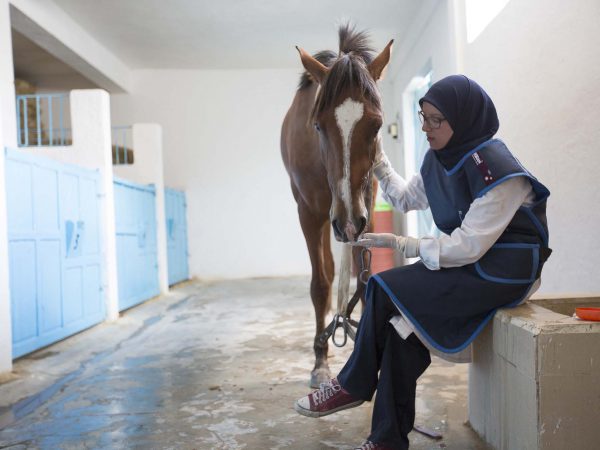
Our team also provides training to owners in providing proper care for their animals, and invaluable training for veterinary professionals. Our clinical skills centre gives trainee vets the opportunity to improve their technical and practical skills.
Working Animals International believes one of the most effective ways of ensuring a better future for working animals is to educate children about animal welfare from an early age. Our extensive education programme in Morocco teaches thousands of children each year. Children visit all of Working Animals International’s centres where they take part in animal welfare classroom-based activities and tour the clinics to see working animals being treated. They also get the chance to come into contact with animals, which helps to develop their knowledge of working animals. A Working Animals International mobile exhibition unit also tours schools in rural areas.
Working Animals International also helps working animals in times of crisis. On 8 September 2023, Morocco was struck by a 6.8-magnitude earthquake. Within days of the earthquake, we launched the most ambitious emergency response project in our charity’s history. Our veterinary teams headed to the epicentre to provide lifesaving treatment and care to thousands of animals who had been injured and displaced. In the months that have followed, we continue to distribute emergency feed and provide veterinary care to affected working animals.
Q&A with Working Animals International Morocco Country Director Professor Hassan Alyakine
How long have you worked with Working Animals International?
I started working with Working Animals International (then called SPANA) in 1991 at our veterinary centre in Rabat, located about 320km (200 miles) north of Marrakech. I was then responsible for the charity’s centre in Casablanca between 2008 and 2013. I was appointed Country Director for Morocco in January 2014.
What role do working animals play in Morocco?
As in many other African countries, donkeys, horses and mules continue to play a crucial role in the life of often impoverished communities and in the country’s economy. They remain an important means of traction in agriculture and are also used to transport goods and people, both in rural areas and around major cities.
Why is Working Animals International’s work important in Morocco?
The work that Working Animals International has been doing in Morocco for decades is invaluable, helping working animals and the communities that depend on them. This has contributed a lot to improving animal welfare.
What have been your biggest achievements?
Working animals face very significant problems, such as harness injuries and lameness, but these problems are often compounded by the lack of appropriate animal welfare legislation. That’s why one of Working Animals International’s greatest achievements in recent years was to contribute to the development of local laws for the protection of carriage horses in Aït Ourir, near Marrakech, and mules used in tourism in Imlil, in the High Atlas Mountains. These two initiatives have greatly improved animal welfare. Similarly, the charity was able to help working animals and their owners throughout the global coronavirus (Covid-19) pandemic by providing emergency feed.
Do you have a message for Working Animals International supporters?
Enormous thanks to all Working Animals International supporters! Without your help and support, none of our work could be accomplished.
Other countries we work in
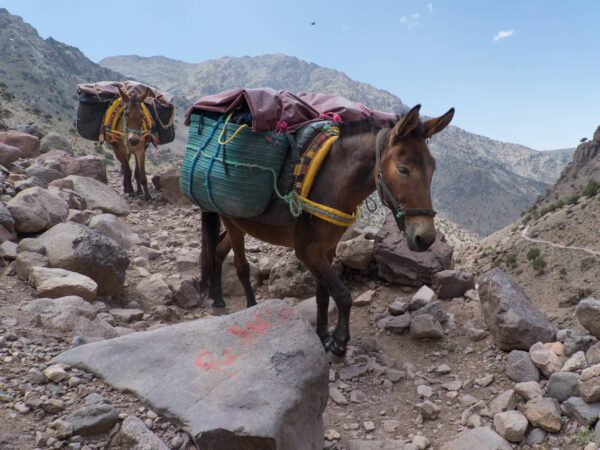
Morocco earthquake appeal: One year on, working animals still need your help
Find out more about how Working Animals International helps working animals in Morocco.
Donate by text
Find out more about how Working Animals International helps working animals in Morocco.
Write Your Will For Free
Find out more about how Working Animals International helps working animals in Morocco.